

Prefab cabin
I have found results from100000+products and40000+suppliers aboutPrefab cabin
Commonly Used:
US$
—
Customization Available
Sample Available
Manufacturer First
Product Attributes:
Type: Two Bedroom
Material: Sandwich Panel
Finished Goods Warehouse
Fast Installation: Fast Installation
Feature: Earthquake Resistant
10-19 Square Meters
Customized Or Not: Customized
Application: Hotel
Design Style: Modern
Layers: Double-Layer
Style: Modern
Certificate: CE
Material: Steel Structure
Material: Metal
Material: Container
Fast Installation: Standard Installation
Feature: Easily Movable
Feature: Eco-Friendliness
Feature: Flexibly Combinable
Feature: Leak Proof
Feature: Moisture Proof
Feature: Safe
Feature: Thermal Insulation
Feature: Waterproof
Feature: Wind Resistance
Application: Villa
Application: Office
Application: Warehouse
Application: Apartment
Certificate: ISO

Satisfies 1 requirement
Expanded Port Cabin House/Prefab Modular Container Cabin House Building
Negotiable
2 Pieces(MOQ)

Satisfies 1 requirement
Prefab Foldable Container Cabin for Project Contractor and Site Manager Work
US$3,000.00-10,000.00
1 Piece(MOQ)

Satisfies 1 requirement
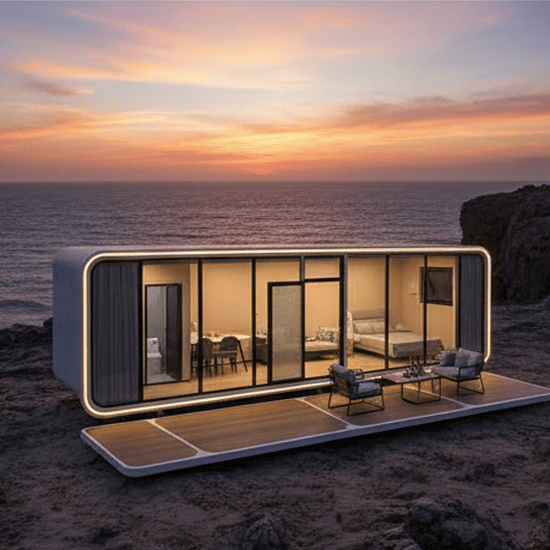
Apple Cabin Container House Prefab Tiny Home off-Grid Apple Cabin Energy-Saving for Remote Countryside Self Sufficient Homestays
US$5,600.00-12,800.00
1 Set(MOQ)
Satisfies 1 requirement
Modular House Prefab Tiny Mobile Space Capsule Home House Modern Prefabracated Container Building Container Apple Capsule Cabin Homestay Factory Price
US$5,500.00-6,000.00
1 Piece(MOQ)

Satisfies 1 requirement
Factory Movable Modular Prefab Portable Office Low Cost Customized Apple Cabin Capsule
US$4,000.00-9,900.00
1 Piece(MOQ)

Satisfies 1 requirement
Luxury Prefab Apple Cabin Modular Tiny House for Vacation Home
US$4,199.00-4,299.00
1 Set(MOQ)

Satisfies 1 requirement
Modern Smart Prefab House Portable Space Capsule Cabin for Tourist Attraction Hotel Accommodation
US$399.00-2,999.00
1 Ton(MOQ)

Satisfies 1 requirement
Extended Foldable Prefab Container Homes/40FT Folding Living Container/Expandable Cabin
US$4,957.00
2 Pieces(MOQ)

Satisfies 1 requirement
Faster Operation Commercial Complex Indoor Outdoor Cafe Use Portable Cabin Tiny Prefab Cabin Home
US$3,599.00-9,999.00
1 Piece(MOQ)

Satisfies 1 requirement
Custom Galvanized Steel Frame Waterproof Prefab Modular Tiny Living Pod with Full Kitchen Bathroom 20FT Movable Outdoor Vacation Apple Cabin House
US$4,800.00-8,999.00
1 Piece(MOQ)

Satisfies 1 requirement
Prefab Luxury Tiny Capsule House Prefabricated Apple Cabin for Sunshine House Shop Office
US$4,150.00-4,800.00
1 Set(MOQ)


Satisfies 1 requirement
Modern 20FT Expandable Portable Prefab Modular Mobile Ready to Move Prefabricated Luxury Apple Cabin
US$3,399.00-4,299.00
1 Set(MOQ)

Satisfies 1 requirement
Container Space Capsule Prefab Smart Luxury Prefabricated Cabin for Camping Site
US$21,800.00
1 Piece(MOQ)

Satisfies 1 requirement
Movable Prefab Prefabricated Hotel Apple Cabin Apple Pods Cabins House Prefab 20FT 40FT Tiny Home for Office Coffee Shop
US$4,500.00
1 Piece(MOQ)

Satisfies 1 requirement
Durable Smart Prefab Apple Cabin for Park Pre-Built Leisure Area
US$3,800.00-7,600.00
1 Piece(MOQ)

Satisfies 1 requirement
Mineral Wool Insulated Prefab Cabin, Noise Reduction, for Highway, ISO
US$3,199.00-8,199.00
1 Piece(MOQ)

Satisfies 1 requirement
2025 Trending Prefab Tiny Mobile Apple Cabin Modern Vessel Mini Airship Pod Hotel
US$200.00-280.00
15 Square Meters(MOQ)

Satisfies 1 requirement
Sound-Insulated Heat-Insulated Prefab House Capsule Apple Cabin for Scenic Area Hotels
US$3,550.00-12,000.00
1 Set(MOQ)

Satisfies 1 requirement
Portable Modular Prefab Office Cabin with Integrated Whiteboard Wall Covering
US$2,899.00-3,199.00
5 Pieces(MOQ)

Satisfies 1 requirement
Modular Prefab Cabin with Detachable Steel Components and Configurable Utility Layout
US$998.00
1 Set(MOQ)

Satisfies 1 requirement
Customized Modern Style 20FT Prefab Featured Luxury Hotel Apple Cabin
US$3,590.00-4,120.00
1 sets(MOQ)

Satisfies 1 requirement
Prefab Apple Cabin, Eco Waterproof Mobile Building for Homestay & Office
US$5,420.00-5,880.00
1 Piece(MOQ)

Satisfies 1 requirement
Superb Value for Money Prefab 3 Bedroom Apple Cabin
US$4,400.00-4,700.00
1 Piece(MOQ)

Satisfies 1 requirement
New Design Modern Prefab Single Luxury Apple Cabin
US$2,000.00-15,000.00
1 Piece(MOQ)

Satisfies 1 requirement
Prefab Barrack Complex Apple Cabin for Modern Glamping Retreats
US$7,650.00-8,090.00
1 Set(MOQ)

Satisfies 1 requirement
Modular Home Apple Cabin Mobile Prefabricada Tiny House Modern Prefab Home
US$5,416.00-6,377.00
1 Piece(MOQ)

Satisfies 1 requirement
20/40FT Prefab Cabin Houses Garden Living Container Homes Apple Cabin
US$9,999.00-12,708.00
1 Piece(MOQ)

Satisfies 1 requirement
Modern Waterproof Prefab Sandwich Panel Cabin for Outdoor Living
US$4,599.00-6,299.00
1 Set(MOQ)
Sourcing guidance for Prefab Cabin
What are the key technical specifications to consider when selecting a prefab cabin?
When sourcing prefab cabins, prioritize structural integrity and material durability. Ensure the main frame uses galvanized steel to prevent corrosion, especially for coastal or humid environments. For insulation, look for polyurethane (PU) or rock wool sandwich panels with a thickness of at least 50mm to 100mm to ensure thermal efficiency. Additionally, verify that the floor loading capacity meets your specific use case, typically requiring a minimum of 250kg/m² for residential use.
Which international compliance standards and certifications are mandatory for prefab cabins?
Compliance is critical for legal installation. You must ensure the supplier provides CE marking for the European market or meets local building codes (such as IBC in the US or AS/NZS 1170 in Australia). Electrical systems must be pre-installed according to UL, ETL, or SAA standards depending on the destination country. Furthermore, check for ISO 9001 certification of the manufacturing facility and fire resistance ratings (Class A or B1) for all wall and roofing materials.
How can I evaluate the weather resistance and longevity of a prefab cabin?
A high-quality prefab cabin should have a service life of 20-30 years. Ask for test reports regarding wind load resistance (typically Grade 10-12) and snow load capacity. The exterior paint should be fluorocarbon (PVDF) or powder-coated to resist UV degradation and fading. For cabins intended for extreme climates, ensure the windows are double-glazed tempered glass with broken bridge aluminum frames to prevent thermal bridging.
What customization and integration capabilities should I look for in a supplier?
Professional suppliers on Made-in-China.com should offer modular flexibility, allowing for the expansion of units. Verify if they provide CAD/3D design support for interior layout customization. It is also essential to confirm if the cabin comes with integrated plumbing and electrical 'plug-and-play' systems, which can reduce on-site installation costs by up to 60%.
Cross-Border Purchasing Considerations for Prefab Cabins
What are the primary logistics risks and shipping methods for prefab cabins?
Prefab cabins are bulky; therefore, shipping costs can significantly impact the total budget. Most units are shipped as Flat-Pack (SOC) to save space or as fully assembled units in 40ft HQ containers. Ensure the supplier uses heavy-duty protective packaging and moisture-absorbent materials to prevent rust during sea transit. Always clarify the Incoterms (FOB vs. DDP) to understand who handles the complex unloading process at the destination.
How can I ensure transaction security and quality control when buying from overseas?
To mitigate risk, utilize secured payment services provided by reputable platforms like Made-in-China.com. It is highly recommended to hire a third-party inspection agency (like SGS or Intertek) to conduct a pre-shipment inspection. This inspection should focus on waterproof testing (hose test), electrical circuit safety, and dimensional accuracy against the approved blueprints before the final balance is paid.
What are the common pitfalls in customs clearance for prefabricated structures?
Customs authorities often scrutinize prefab cabins for wood packaging materials (WPM); ensure all wooden components or pallets are IPPC heat-treated and stamped. Additionally, provide a detailed HS Code classification (typically 940690) to avoid incorrect duty applications. Be aware of anti-dumping duties that may apply to steel structures in certain regions and ensure all Certificates of Origin are prepared to leverage trade agreements.
What strategies should be used when negotiating with prefab cabin manufacturers?
Negotiate based on Total Cost of Ownership (TCO) rather than just the unit price. Request a tiered pricing structure where the price drops by 10-15% for orders exceeding 5 units. Ask for a spare parts kit (extra sealants, touch-up paint, and fasteners) to be included at no extra cost. Finally, negotiate a warranty period of at least 2-5 years on the main structure to ensure long-term supplier accountability.